How units and conversions work
Units are grouped by dimension — volume, mass, or count — and Catertoo converts freely within each group.
Last updated May 25, 2026
The three dimensions
Every unit belongs to one of three dimensions:
- Volume — tsp, tbsp, fl oz, cup, quart, gallon (US); ml, l (metric)
- Mass — oz, lb (US); g, kg (metric)
- Count — each, dozen
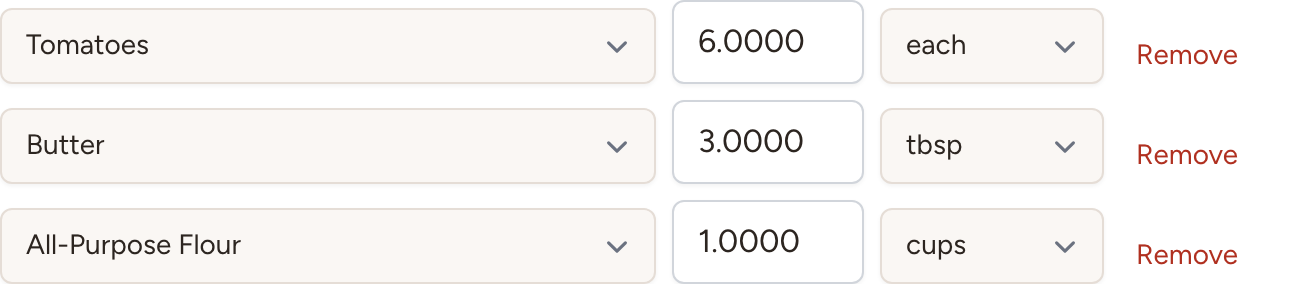
When you pick a unit for a recipe line, Catertoo records which dimension that quantity belongs to. Conversions are only possible within the same dimension — you cannot convert a volume to a mass.
How conversions happen
All quantities are stored as exact values and converted through a precise base unit (millilitres for volume, grams for mass, and "each" for count). There is no floating-point rounding during the conversion — the math stays exact until the very last step when a quantity is displayed.
When a quantity is shown to you, Catertoo walks the unit ladder from smallest to largest and picks the first unit where the value falls below that unit's step-up threshold. For example, 48 tsp becomes 1 cup rather than staying as 48 tsp.
Mixing US and metric units
You can freely mix US and metric units on different recipe lines — flour in grams, milk in cups — because each line is converted independently in its own system when displaying. The shopping list accumulates totals per ingredient per dimension, then formats each total in the system of the units used on the contributing lines.
Count units
Count units (each, dozen) behave the same way. 12 each is shown as 12 each; 24 each steps up to 2 dozen.
What's next?
- Build recipes from ingredients — where units are entered on recipe lines.
- Generate an event shopping list — how totals across multiple recipes are combined.